
Gain insights into the Armenian banking sector with Grant Thornton Armenia’s in-depth analysis of bank performance from 2015–2023, using dynamic Tableau dashboards.
Grant Thornton’s Virtual office is an innovative platform that completely changes the existing model of delivering our services to your business. It integrates the crucial tools necessary for smooth running of such business processes, as communication, document exchange, task management, financial and operational reporting, with advanced analytics and easy-to-understand visualization in one space. We have designed the Virtual Office to make your collaboration with Grant Thornton’s team significantly efficient and more comfortable. The platform is intended for executives and managers of Grant Thornton's partner organizations and decision-makers.
New technology breakthroughs, further shifting consumer consumption patterns and prevalence of big data and data analytics have led to redefining business models, against a changing regulatory environment and growing age of globalization.
Grant Thornton experts suggest ideas on what to consider regarding cost cutting in a difficult time for the business and what is important for implementing effective cost optimization.
In this publication Grant Thornton Armenia has summarized key aspects that will help leaders and communication professionals design a smooth response in critical situations or test their existing communication plan.
With this publication the advisors of Grant Thornton Armenia present to your attention the importance of business transformation, big data processing and analysis of various aspects of business operations in the modern world as one of the key success factors in defining business strategies and risk management policies.
Every business can benefit from the Internet of Things – just start small and choose wisely when deciding which operations you want to target.
For tomorrow’s billion-dollar tech companies, the challenge and complexity of tax should never be underestimated.
As productivity rates fall, businesses and governments need to find new ways to make inputs work harder if living standards are to be maintained.
Tomorrow, we can expect new technologies enabling the internet of things to create opportunities for future fast-growth companies. Some will become industry leaders – the Xiaomis and Ubers of tomorrow. Many more will fail – either because their offering wasn’t differentiated enough, or because their management made the wrong decisions.
As global attitudes towards tax change, tech companies need to future-proof their tax practices to stand up to enhanced scrutiny. The way in which companies markets and sells its services can also have tax implications. Therefore, one thing is clear – tax matters, and ambitious tech companies need to develop a tax strategy that can keep pace with their growth aspirations.
Cyber-attacks are set to grow in their number and nature; those companies that embed security measures into their culture will be most successful at fending them off, says Paul Jacobs
New research from Grant Thornton reveals that cyber attacks are taking a serious toll on business, with the total cost of attacks globally estimated to be at least US$315bn* over the past 12 months. The Grant Thornton International Business Report (IBR), a global survey of 2,500 business leaders in 35 economies, reveals that more than one in six businesses surveyed faced a cyber attack in the past year. With high-profile security breaches and hacks becoming more prevalent, nearly half of firms are putting themselves in the firing line with no comprehensive strategy to prevent digital crime.
Low productivity growth is a concern for policymakers across the globe. Steve Perkins, global leader for technology, says boosting R&D is the way to compensate for ageing populations and slower employment growth.
Rising labour costs and the quest for productivity are driving businesses to automate. Finding new roles for redundant workers will be the next challenge.
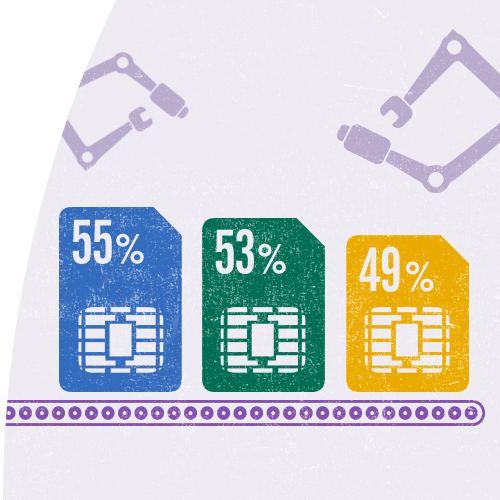
Fifty years on from the world’s first personal computer going into mass production, the Grant Thornton International Business Report reveals the scale of technology’s influence on business with the majority of firms now planning to automate operations and practices, potentially resulting in job losses.